

Preventing AI Hallucinations from Ruining Customer Trust
We've all seen the headlines: an airline's AI chatbot promises a refund policy that doesn't exist, or a dealership's automated assistant agrees to sell a car for a dollar. While large language models (LLMs) have revolutionized customer support by providing instant, 24/7 responses, they come with a critical flaw: hallucinations.
When an AI confidently presents false information as fact, it doesn't just cause a temporary glitch—it actively damages customer trust and can lead to significant financial or legal liabilities.
As businesses deploy AI agents for increasingly complex tasks, preventing these hallucinations from reaching the end-user is paramount. The solution isn't just better prompt engineering; it's implementing a robust human-in-the-loop (HITL) safety net.
The Limits of "Perfect" Prompting
A common misconception in AI development is that if you just refine your system prompts enough, or provide a large enough knowledge base, you can eliminate hallucinations entirely.
The reality is that LLMs are probabilistic engines. They are designed to predict the next most likely word, not to access an internal database of absolute truth. When faced with an unprecedented edge case, a nuanced complaint, or conflicting documentation, the AI will often guess—and it will do so with absolute confidence.
For low-stakes interactions (like asking for store hours), a slightly confused AI is an annoyance. For high-stakes interactions—billing disputes, technical troubleshooting, or account recovery—an AI hallucination can be disastrous.
Designing the Human-in-the-Loop Safety Net
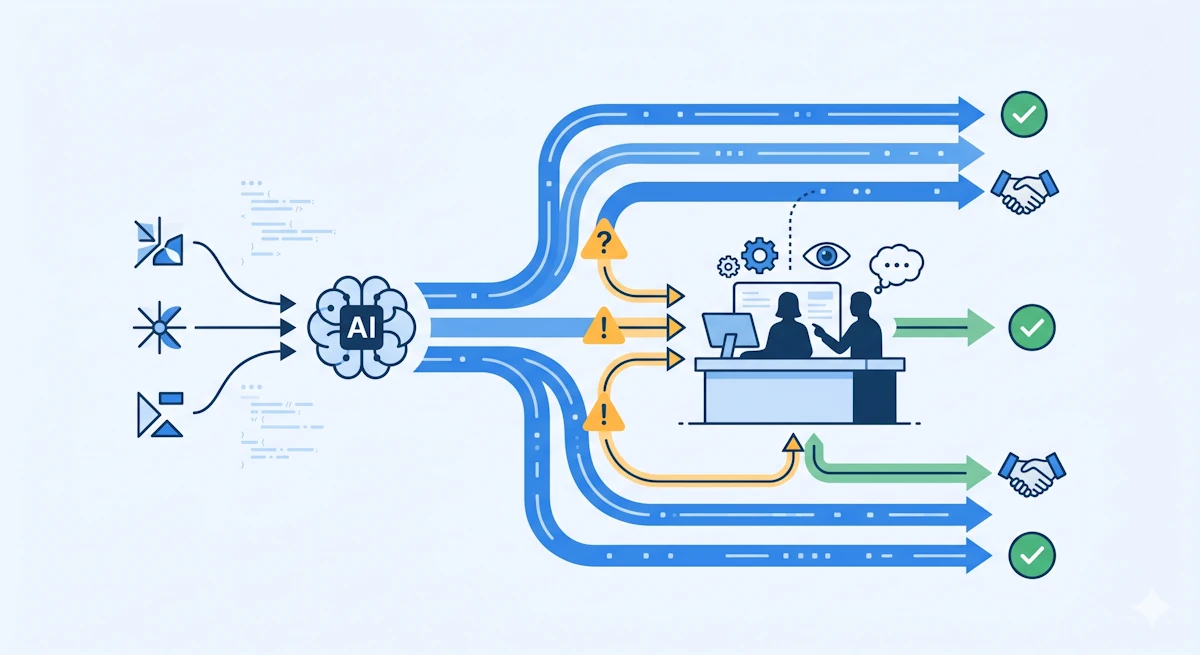
To protect your brand, you need a structural safeguard. Instead of hoping the AI gets it right 100% of the time, modern agentic workflows are designed to identify uncertainty and immediately pause the interaction.
Here is how a functional HITL safety net operates:
- Confidence Thresholds and Sentiment Analysis: The AI is equipped with tools to monitor the conversation. If the user expresses deep frustration, or if the AI detects that a query falls outside its strictly defined capabilities, it triggers an escalation.
- The "Bailout": The AI stops generating responses and smoothly informs the customer, "I want to make sure I get this exactly right for you. I'm passing this over to a human specialist."
- The Handoff: Control of the conversation is transferred from the automated agent to your human support team.
Why a Standalone Alert Isn't Enough
Many engineering teams attempt to build this handoff mechanism internally, often reducing it to a simple webhook that fires a notification into a Slack channel or an email inbox.
However, alerting a human that an escalation has occurred is only the first step. When an operator steps in, they are stepping into the middle of an ongoing conversation. If they don't have immediate access to the context, they will end up asking the customer to repeat themselves—which further erodes trust.
Effective escalation requires a full-featured UI where your team can actually take action. Human operators need a dedicated operational console to:
- Review the Transcript: Instantly read the entire preceding conversation between the user and the AI.
- Understand the Trigger: See exactly why the AI decided to bail out.
- Resolve the Issue: Reply directly to the customer across whatever channel they are using (WhatsApp, Messenger, Telegram, etc.) from a single dashboard.
Restoring Confidence with Escalation-as-a-Service
Your customers don't mind talking to AI, provided the AI knows when to step aside. By utilizing an Escalation-as-a-Service platform like AwaitHuman, you provide your team with the operational console they need to intercept edge cases smoothly.
Instead of treating human intervention as an afterthought or a messy developer workaround, you elevate it to a core feature of your customer experience. You get the scale and speed of autonomous AI, backed by the empathy, accuracy, and accountability that only a human operator can provide.
Protect your customer experience from edge cases and hallucinations. Discover how the AwaitHuman platform empowers your team to take control when it matters most.
When "Autonomous" Isn't Enough: The Case for Human-in-the-Loop AI
A thought piece challenging the hype around 100% autonomous agents and why the most successful businesses will always keep a human in the loop.
Why AI Agents Need a "Bailout" Button: Designing Plug-in Escalation Systems
Explore the architectural shift from constant middleware proxies to lightweight, plug-and-play human-in-the-loop escalation components for AI agents.