

Why AI Agents Don't Need PagerDuty Logins: The Case for Escalation-as-a-Service
Why AI Agents Don't Need PagerDuty Logins: The Case for Escalation-as-a-Service
PagerDuty is built for one world: humans managing incidents.
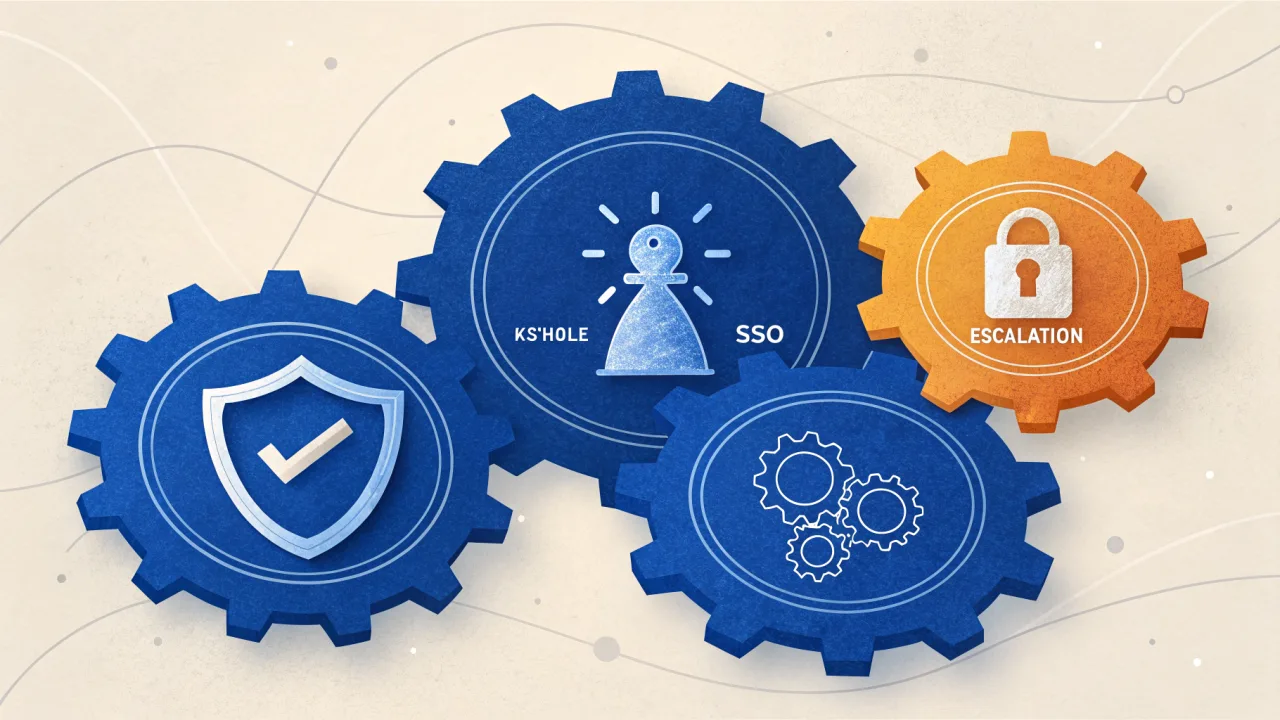
Your on-call engineers log in, acknowledge alerts, and remediate issues. The login is the gate. The faster they authenticate, the faster they act. This is incident response optimized for human workflows.
But the infrastructure landscape is changing. AI agents now monitor systems, make autonomous decisions, and execute actions. When an agent encounters a boundary condition (a financial threshold, a customer account change, a security-sensitive action), it cannot simply make the call alone. It needs to escalate to a human. But does that human really need to log into PagerDuty?
The Problem: Human Authentication for Machine Escalations
Traditional incident management systems like PagerDuty assume human-to-human escalation. A person receives a notification, authenticates, reviews context, and decides. The login is necessary because the human needs a secure session to access sensitive operational data.
But when an AI agent escalates, the dynamics are different. The agent isn't requesting access to a dashboard. It's requesting a human decision. The agent already has full context: the reasoning trace, previous actions, tool results, and the specific decision it cannot make. Forcing the human to log into another system doesn't add security. It adds friction.
According to research on incident response workflows (as detailed in incident management best practices), authentication overhead during critical escalations can delay human intervention by 30-90 seconds. For a system handling thousands of agentic decisions daily, this friction compounds quickly.
How Traditional Systems Handle AI Escalation (Poorly)
PagerDuty SSO Integration
Teams using PagerDuty's SSO capabilities (typically SAML-based with providers like Okta or OneLogin) can speed authentication. A user with a remembered session logs in under five seconds. But this still assumes the human is available, at a terminal, and ready to context-switch into a dashboard. For 3 AM escalations, this friction is real.
Email-Based Notifications
Some teams configure email notifications from PagerDuty and try to embed approval links in the email. But escalation context (the agent's reasoning, previous actions, tool failures) doesn't fit neatly in an email body. The human still needs to click through to a dashboard to see the full picture.
Webhook Workarounds
A few teams build custom webhook handlers that send alerts to Slack, but without standardized escalation infrastructure, these solutions lack compliance trails, reasoning context preservation, and reliable human confirmation.
The AwaitHuman Model: Escalation Without Login
This is where AwaitHuman differs fundamentally. We provide escalation-as-a-service specifically designed for agentic workflows.
Instead of login-then-decide, the flow is simple: agent pauses, human decides, audit trail captures reasoning.
Here's how:
1. Agent Sends Escalation via Webhook
The agent encounters a decision it cannot make. Instead of failing or guessing, it sends a single webhook with full context: the decision point, the agent's reasoning trace (from Claude, OpenAI, or any LLM), previous actions, and the options under consideration.
2. Human Gets Notified Omnichannel
The operator receives a notification via their preferred channel: Push notification, Email, SMS, Telegram, or WhatsApp. No login required yet.
3. Human Reviews in Context
When they click the notification, they land in an intervention dashboard showing the full reasoning context. What did the agent try? Why did it get stuck? What decision is needed? No context-switching, no dashboard hunting.
4. Human Approves or Overrides
The human makes a decision: approve, reject, modify, or escalate further. This decision is immediately returned to the agent via the same webhook channel.
5. Immutable Audit Trail Captures Everything
Every escalation, every human decision, and every reasoning trace is logged immutably. Compliance teams can audit agent behavior, and model improvement teams can use the logs to fine-tune prompts.
No login credentials required for the human. No additional dashboards. No compliance gaps.
Comparing the Approaches
| Dimension | PagerDuty (SSO) | Email + Custom Logic | AwaitHuman |
|---|---|---|---|
| Setup time | Hours to days (SSO integration) | Days (custom code) | Minutes (webhook only) |
| Reasoning context preserved | No | Partial (email limitations) | Full (JSON payload + dashboard) |
| Compliance-ready audit trail | Limited (login logs only) | None | Complete (reasoning + decision + timestamp) |
| Omnichannel alerts | PagerDuty only | Slack/email workarounds | Push, Email, SMS, Telegram, WhatsApp |
| Time to human decision | 30-90 seconds (auth overhead) | 5-10 seconds (notification only) | 2-5 seconds (no auth needed) |
| Single integration point | Requires custom event routing | Multiple systems | Single webhook |
When PagerDuty Is Still Right
PagerDuty remains the gold standard for human-driven incident response. If your on-call team is managing human alerts (application errors, infrastructure issues, customer-reported problems), PagerDuty is built for that. Its escalation policies, on-call rotations, and handoff workflows are mature and proven.
But if you're running AI agents that need human oversight (approval queues for chatbots, safety gates for autonomous workflows, compliance escalations for financial agents), PagerDuty login flows introduce unnecessary friction.
The Real Difference: Context Preservation
The deepest insight: traditional incident management optimizes for alert latency, not decision context.
PagerDuty asks, "How fast can I notify someone?" AwaitHuman asks, "How do I preserve every scrap of reasoning so the human can decide confidently without context-switching?"
When an LLM agent makes a decision and gets stuck, it has reasoning worth capturing: what it tried, why it failed, what constraints apply. That reasoning is golden data for compliance teams, model improvement, and human decision-making. If you log the agent's action but not the reasoning, you've lost the signal.
Our audit trail feature captures the full trace: the LLM call, the tool responses, the agent's internal state, and the human's decision. This is why regulatory teams (HIPAA, SOC 2, financial services) prefer structured escalation over ad-hoc PagerDuty integrations.
Getting Started
If you're building AI agents with Claude, OpenAI, or LangChain, and you've hit the wall where agents need human judgment calls, AwaitHuman is free during beta. You can integrate in minutes:
- Add AwaitHuman's webhook to your agent's decision logic.
- Configure omnichannel notifications (Slack, email, SMS, or whatever your team prefers).
- Route escalations to the AwaitHuman dashboard.
- Start capturing compliance-ready audit trails.
For teams running production agentic workflows, the question isn't "How do I log into PagerDuty?" It's "How do I escalate safely to humans without losing context?" AwaitHuman is purpose-built for that.
Learn More
- What Is the AI Escalation Process: A complete guide to safe agentic escalation.
- AI Agent Audit Trail Compliance: Why capturing reasoning traces is essential for compliance and model improvement.
- Escalation Triggers for LLM Agents: How to define when agents should escalate.
Awaithuman: pagerduty notifications
PagerDuty notifications are built for human-initiated incidents, not for AI agents that need to pause, present reasoning traces, and resume after human judgment. Here's what a purpose-built escalation layer looks like.
PagerDuty Login in 2026: Beyond the Password to SSO and Agentic Escalation
PagerDuty login has evolved from a simple email-password flow into a multi-layered access system with SSO, identity provider integration, and subdomain routing. This article explains how login connects to broader incident response and how AwaitHuman complements it for agentic workflows.